Accessing Oracle Fusion GL Account Hierarchies with REST API Overview In Oracle Fusion Cloud Financials, General Ledger (GL) account hierarchies are implemented using the Trees framework. An account hierarchy is a Tree defined under a Tree Structure and can have multiple date-effective versions. The most practical REST approach for reading…
Pause/Resume OIC Integrations as per Oracle Fusion Patch Cycle
1. Summary Lot of times we have a need to pause all OIC integrations, primarily for ex. when there are scheduled downtimes. Below is a tentative, production‑ready solution design for managing pause and resume of scheduled integrations in Oracle Integration Cloud (OIC). In this solution, integration state is persisted in…
SOA AQ Adapter with Oracle AQs

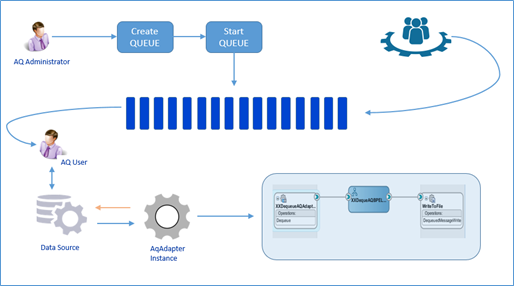
In this post I will discuss about how to dequeue messages from Oracle Advanced Queues using Oracle SOA AQ Adapter. The intension of this post is to understand Oracle SOA AQ Adapters. But as you need a queue to be dequeued, I will discuss about how to create custom queues,…
How to use SOAP header in oracle SOA
To depict using SOAP header, let us consider below test case. Perform below enhancement in the card validation system. Accept vendor name in SOAP envelope section. If vendor name is visa and credit card number is >5000, then status is valid, else if vendor name is not visa and/or credit…
An example of integration using SOA

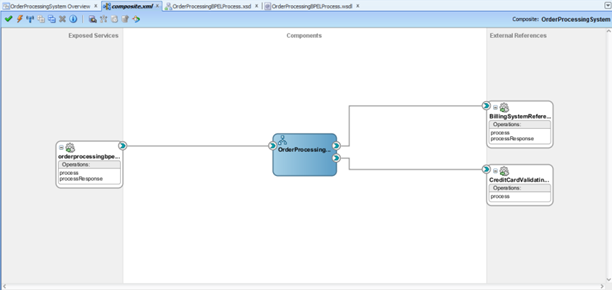
Create a SOA project that will accept order as an input and generate invoice as output. Step 1: Create a new SOA project and name it as order processing system. Note: In a SOA project if we want to communicate with an external program (SOA or any other technology) then…
Meta data services (MDS) in SOA
In oracle SOA suite, we use MDS to store reusable artifacts for example xsd, wsdl, xsl, fault, policies documents, etc… MDS configured in DEV_MDS database schema that is installed with RCV. We have two types of MDS. Design time MDS Run time MDS Design time MDS should be configured in…
Types of variables in BPEL
Variables in BPEL programming function just as they do in other programming languages: they hold temporary values, form parts of expressions, or are passed as parameters to external partners. Normally, you need a variable for every message sent to or received from a partner service. The BPEL Designer supports the…
How to create asynchronous BPEL process in SOA

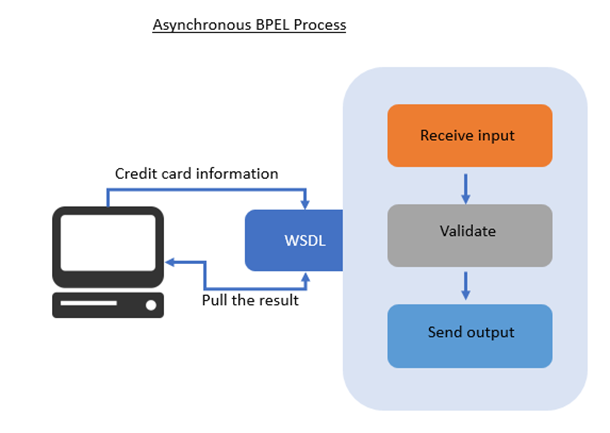
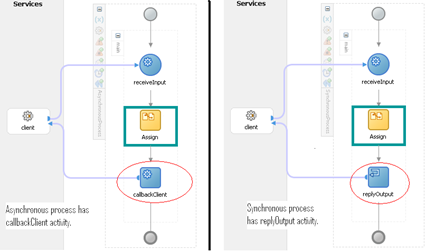
In the asynchronous process two one way operations ports are defined to receive the request and send the response. On the client side, the client uses the invoke activity to invoke the asynchronous BPEL process and continues with its flow. It uses the receive activity to receive the response later in the flow. The asynchronous…
How to create Synchronous BPEL process in SOA

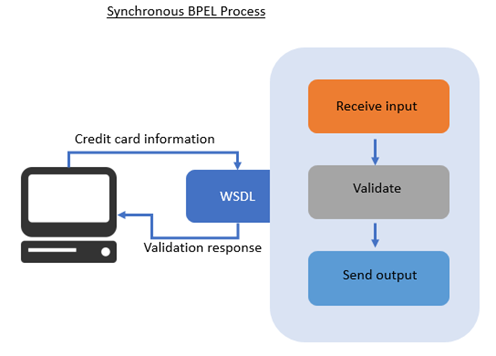
The synchronous process defines one two-way operation port to receive the request and send the response back. Using the invoke activity, client invokes Synchronous BPEL process on this port and waits to receive response on the same port. As soon as the client receives response from BPEL process it continues with its flow. On the…
Asynchronous vs Synchronous BPEL process in SOA

This article explains the difference between an asynchronous and a synchronous process with the help of a simple example below: Suppose there are two processes SynchronousBPELProcess and AsynchronousBPELProcess. Also, there is a third process which we’ll call as Client. The Client invokes the above processes. If client invokes SynchronousBPELProcess. Client…